Spiritual teacher Kabir Helminski was given the task of grooming a horse one day at what he called ‘spiritual school.’ His teacher instructed him to groom the horse from head to tail. Kabir worked hard. He spent hours with the horse, absorbed in his lesson. When the teacher came over he was unimpressed and told Kabir his work was sloppy. Understandably the student’s heart sank. You might think the lesson was: try harder, next time, pay more attention, don’t cut corners on the difficult parts, those feathers on the fetlocks need more brushing.
The teacher was joking, playing a game with Kabir to see whether he truly was paying attention to what mattered. Kabir understood he had not spent hours polishing the horse to a shine to get a reward from the teacher. He had groomed the horse by paying attention to the task, brush stroke by brush stroke. The reward of a well-groomed horse was not the point. The success or failure of his lesson was not going to be determined by outside validation. If Kabir had done his best, that was all.
We are so conditioned to reward, to the polarities of success and failure – our entire education system is built on these twin shaky poles – that paying attention in and of itself seems to be worthless.
Addressed properly, with respect for what we know to be true, attention can glisten like fine silken spiders’ webs in autumn sun. Attention can lead us toward the delightful state of not needing approval.
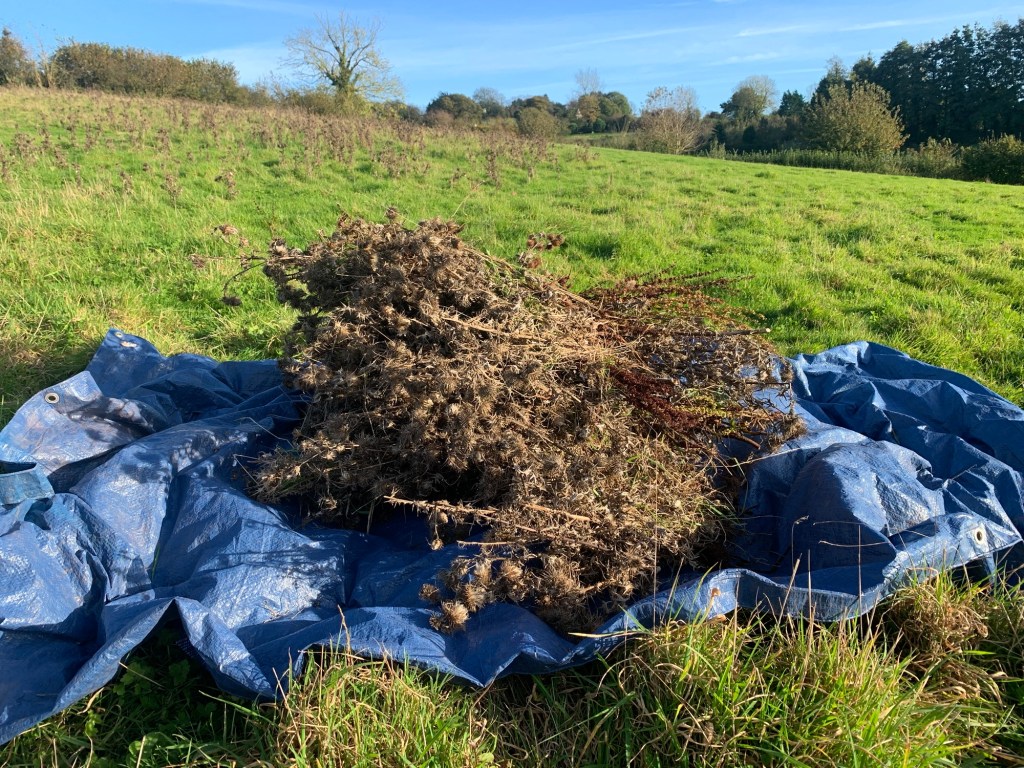
I recognised my own conditioning in anticipating reward as I pulled up thistles in the horses’ new pasture. It was at first absorbing work and I set small goals of areas to clear, finding my motivation rising as I neared the end of one section and got ready for the next. My mind made a little game of the activity. I will do this patch and then have tea or play with the dogs or read or send messages. This approach to work is ingrained and possibly has something to do with years of working in schools when work time is sliced into thin sections – in my case, currently, an eight period day.
Breaking large and difficult tasks into manageable chunks is sensible and practical. I am not going to write a whole book in one go. I will write a sentence and then another and each day I will have a few more sentences which will eventually become chapters.
I approached clearing the field like writing a book. I would say I have a first draft now. I know what I am doing and I have a system. Alongside my efficiency, I have given room to thornier questions such as – do these thistles want to be pulled?
They come out of the ground so easily, I have read this as a yes. And thistles have many, many seeds and of course they will be back. Next year. I will be pulling them out of the ground for a long time. And if each thistle were a thought, that would mean I would be endlessly engaging with barbs and spikes and splinters, which sums up any stream of consciousness. The prickles of the mind snag my attention moment by moment. The work of presence, as Kabir teaches it, is to recognise when we are hooked and to gently detach ourselves from distraction.
The average attention span of an adult is 8.25 seconds. Children and young people do so much better – they sit down and write stories, complete geography projects, build castles, compose music. Last night, a 14-year-old pianist named Pacey Shephard stunned a church audience with the brilliance of his playing. From his own haunting composition Rumours of War to a virtuoso arrangement of the theme from Star Wars he was so absorbed in the piano, it was as if we were not there. To our rapturous applause, Pacey took no bow. He had already redeemed his reward. It was no reward. He played with every part of his being. You could feel it.
Total attention is not possible all of the time. Kabir is not suggesting we try to aim for an impossible focused ideal of uninterrupted awareness. He knows having studied with many master teachers, how difficult it is to pay attention even for a short time. Struggling and failing will not teach us how to do something better whether that is grooming a horse, painting a shed or pulling a thistle.
It is only through being aware of what we are doing in the moment of doing it that we become free of judgement and commentary. It is hard to give up our stories of virtue and blame. Hard to live in the precise present.
Hard to let go. This is the thorn in us all.


Leave a Reply